3 days to save elephants
Wednesday, 10 March 2010 08:21 am![[personal profile]](https://www.dreamwidth.org/img/silk/identity/user.png) miriam_e
miriam_e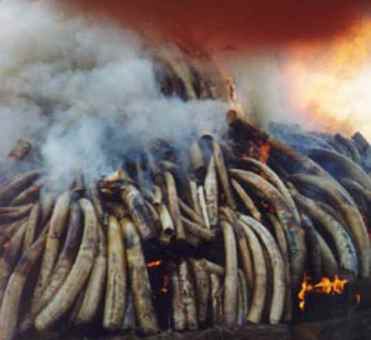 Elephants are highly intelligent and are one of the few animals that can recognise themselves in a mirror. They are social animals who experience great anguish when a member of their group is hurt or dies, they are known to make art, music, show compassion, and look after one another's young. Their long lifespan (they can live to more than 80 years) gives them extremely low birth rates and makes them very prone to extinction. In the wild, adult elephants have no natural enemies, except humans. We were wiping them off the face of the Earth until the international ban on ivory dried up most of the profit in killing them. Now Tanzania and Zambia want to lift the ban on ivory sales, which will open the channels for poachers again, even in countries that keep the ban.
Keep the ban on ivory.
We have a rapidly closing window of 3 days to make public opinion heard here.
https://secure.avaaz.org/en/no_more_bloody_ivory_gg/
![[identity profile]](https://www.dreamwidth.org/img/silk/identity/openid.png)
no subject
Date: 2010-03-13 03:41 am (UTC)I agree with that, when the principles are not basic ones. For example, some people believe that government is better at running large public services, while others believe the opposite. I believe that the reality lies in between, because private competition makes some entities (e.g. banks, airlines) run better, while private competition in some areas (e.g. water supply, electricity supply) is a total waste of resources that doesn't provide anything.
However, there are some principles which are basic and should never be broken, which includes freedom of action, so long as you are not harming others. I can see the possibility of a community deciding that they wanted a nanny government to make our decisions for us, but I don't wish to be a part of such a society and would resist such in any way possible.
no subject
Date: 2010-03-13 05:47 am (UTC)Freedom is always a relative thing though, as my freedom to do things is always circumscribed by my neighbor's freedom to do conflicting things. That's where we have to take account of practical realities. I and my neighbor can tolerate some curtailment of our freedoms in order to obtain wider benefits. Such restrictions of freedoms are ideally voluntary, but in the case of intractable problems may need to be imposed upon some. Reality intrudes here too. Practicality means that the majority will usually win out over a minority (even if the majority is wrong). In cases where a minority succeed in imposing their will upon a majority it is easy to predict long-term instability developing.
I wish it was simple to divide life into clear-cut principles. The closest to a basic principle which I see as almost inviolable is the right to life. However even that is negotiable. I can imagine circumstances where my death might be of benefit to those I care about, or where the death of a dangerous person might be required for survival of others. And although I don't eat meat (unless it is impolite to refuse it), I recognise that others wish to kill animals for food. I don't even kill ants... though I do kill mosquitoes that attempt to sup upon my blood.
Sadly, few things are really basic.
In spite of that I still hold 3 rules as pretty-much central to my existence:
- enhance life
- help other people
- learn
They come from a simple understanding of what is important (for us) in the universe:no subject
Date: 2010-03-15 01:11 pm (UTC)Practicality means that the majority will usually win out over a minority.
I'd suggest that's not "practicality", but subjugation. That's the way we get governments making laws against homosexuality, "unnatural" sexual acts, etc. Basing laws on what the majority does just unnecessarily restricts everyone's rights. My assertion is that outlawing any private interaction (whether it be sexual activity, prostitution, ivory collection, dangerous sports, or whatever) is ultimately bad for human self-determination. Even very dangerous activities, such as keeping of dangerous animals, can be allowed so long as there is a strict regulatory framework in place.
Without freedom, we are limited in our ability to do anything, including enhance life, help other people and learn.
no subject
Date: 2010-03-15 10:34 pm (UTC)In pointing out that reality means we must expect that the majority will often win over the minority I'm not saying I like it. As you say, it has from time to time produced abhorrent results. I'm just pointing out that this is how things work (and, incidentally, why we are unlikely to ever get a blanket ban on ivory). I've been enjoying James Suroweicki's amazing book "The Wisdom of Crowds" lately, which points to some possible ways to avoid just such glaring problems in democracy. I highly recommend it. (Want me to send it to you? Email me at mim at miriam-english dot org if you want me to send it. It's actually an audiobook.)
While I like to agree with your final point that our enjoyment of life is limited by our lack of freedom, that is surprisingly not the case. There are many situations where we can be much happier with reduced freedoms. This is a bit of a worry which I think we should all be very careful of because it can easily become a rationale for restricting freedom beyond what is practical into what is comfortable and then into what becomes draconian repression -- just an interesting side-issue to be aware of.
I'm in favor of maximising our freedoms and limiting how much we tread on the toes of others... even elephants' and other intelligent creatures'. The boundary for each person is where a lot of the problems in society occur.
no subject
Date: 2010-03-15 10:47 pm (UTC)Read about The Wisdom of Crowds on Wikipedia (http://en.wikipedia.org/wiki/The_Wisdom_of_Crowds) and at Amazon (http://www.amazon.com/Wisdom-Crowds-James-Surowiecki/dp/0385721706). And listen to a talk by him that gives the gist of it at ITConversations (http://itc.conversationsnetwork.org/shows/detail468.html) (the audio is freely downloadable).